Education & Strategy

Why Bitcoin Only?

We believe Bitcoin is uniquely positioned to address the financial challenges facing wildlife conservation organisations worldwide.

The Problem

A Broken Monetary System

The global economic and monetary system is characterised by significant vulnerabilities. Governments and central banks can print money at will, leading to inflation that slowly erodes the value of savings. This creates uncertainty for non-profit organisations that depend on donations and long-term planning.

Wildlife conservation organisations in Africa face an especially difficult challenge: traditional financial systems are slow, expensive, and often inaccessible. Currency instability and banking restrictions mean that international donations lose significant value by the time they reach local partners on the ground.

Bitcoin was created as a direct response to these failures. It is a decentralised, permissionless monetary network with a fixed supply of 21 million coins — designed to be resistant to censorship, inflation, and political interference.

For Bitcoin in the Wild, choosing Bitcoin exclusively is not just a financial decision — it is a philosophical and strategic one. Bitcoin aligns with our core values of transparency, sovereignty, and long-term thinking.

Bitcoin's Properties

Sound Money for Conservation

Durability

Bitcoin exists purely as information on a decentralised network. It cannot be destroyed, lost to fire, or confiscated by physical means — making it extraordinarily durable compared to physical assets.

Scarcity

There will only ever be 21 million Bitcoin. This hard cap is enforced by code, not policy. No government, company, or person can increase the supply — making Bitcoin the scarcest monetary asset ever created.

Immutability

Every Bitcoin transaction is recorded permanently on a public blockchain. Once confirmed, it cannot be reversed, altered, or censored. This creates a transparent, auditable record of all financial activity.

The Challenge

Traditional Finance Fails Conservation

Wildlife conservation non-profits face unique financial challenges that traditional banking systems are poorly equipped to solve:

  • High international transfer fees eat into donations before they reach the field
  • Currency volatility in Africa reduces the purchasing power of donations
  • Banking restrictions make it difficult for remote organisations to receive international payments
  • Slow settlement times mean urgent needs cannot be met quickly
  • Intermediaries and middlemen reduce transparency and add administrative overhead
  • Inflation erodes the value of reserves held in local currencies

Bitcoin solves all of these problems simultaneously. It is the first monetary system in history that can send value to anyone, anywhere, instantly, cheaply, and without requiring permission from any bank, government, or financial institution.

The Solution

Adopting Bitcoin — A New Path for Non-Profits

For non-profits that depend on international donations and operate in currencies prone to inflation and devaluation, Bitcoin provides a powerful alternative.

By holding Bitcoin in self-custody, organisations can protect the value of their reserves. By accepting Bitcoin donations, they can receive funds from anywhere in the world with minimal fees. And by operating on the Lightning Network, they can make micro-payments instantly.

For Non-Profits, Bitcoin Provides:

  • Monetary stability — a hedge against local currency inflation
  • Low fees — especially via the Lightning Network
  • Self-custody — full ownership without reliance on banks
  • Borderless payments — receive donations from anywhere instantly
  • Financial independence — no permission needed to transact
  • Long-term store of value — a savings technology, not just a payment method
Bitcoin conference — education and adoption
Did you know? The Lightning Network enables Bitcoin payments that settle in milliseconds with fees measured in fractions of a cent — making micropayments for conservation projects a practical reality.

Ready to Learn More?

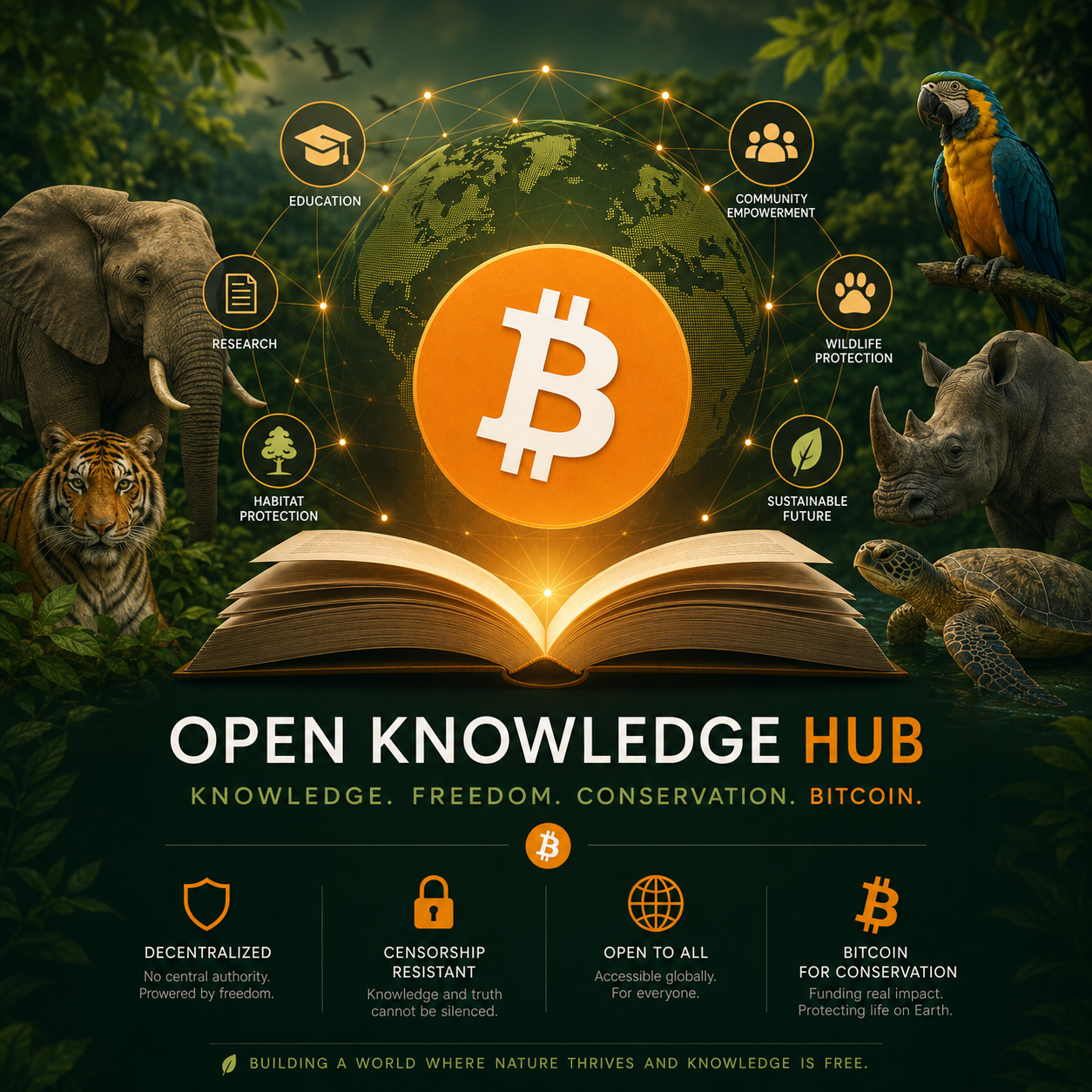
Our Open Knowledge Hub has curated educational resources, videos, study guides, and links to help you understand Bitcoin and how it can protect nature.